
Learning to play the guitar on your own results in something truly valuable: a direct, intimate relationship with the instrument that is solely shaped by self-direction and curiosity. What it rarely provides, at least without purposeful intervention, is the type of technical basis that keeps minor issues from escalating into deeply established habits.
While the Fender Telecaster in the hands of a self-taught guitarist may seem perfectly acceptable to casual listeners, an expert ear will notice a number of technical problems that are actively impeding the player’s advancement and restricting their potential. Most of these problems are invisible to the person making them.
The Thumb Position Nobody Mentions
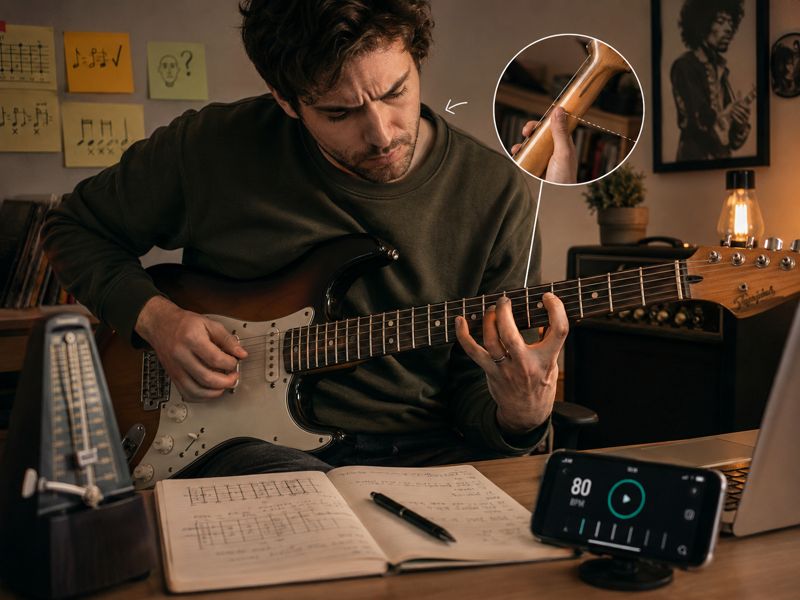
One of the most important technical aspects of playing the guitar is fretting hand thumb position, which is also one of the least talked about in self-teaching settings. The thumb is typically wrapped over the top of the neck and hooked over the side of the low E string in a solid and comfortable grasp.
Finger independence is greatly limited in this position. When the thumb locks the hand into a gripping position, the fretting fingers are unable to spread or arch correctly. Clean execution of chord voicings becomes more difficult. Scale passages that call for independent finger movement seem unduly challenging. Players who believe this difficulty is a reflection of their inherent limits are frequently just dealing with the inevitable fallout from an unquestioned thumb habit.
Hand mobility is unlocked by repositioning the thumb behind the neck, roughly opposite the middle finger, which changes what is possible. The grip feels less firm at first, making the transfer uncomfortable. Rather than being proof that the new position is incorrect, the initial soreness is the feeling of the hand acquiring a better functional posture.
Practising Without a Click
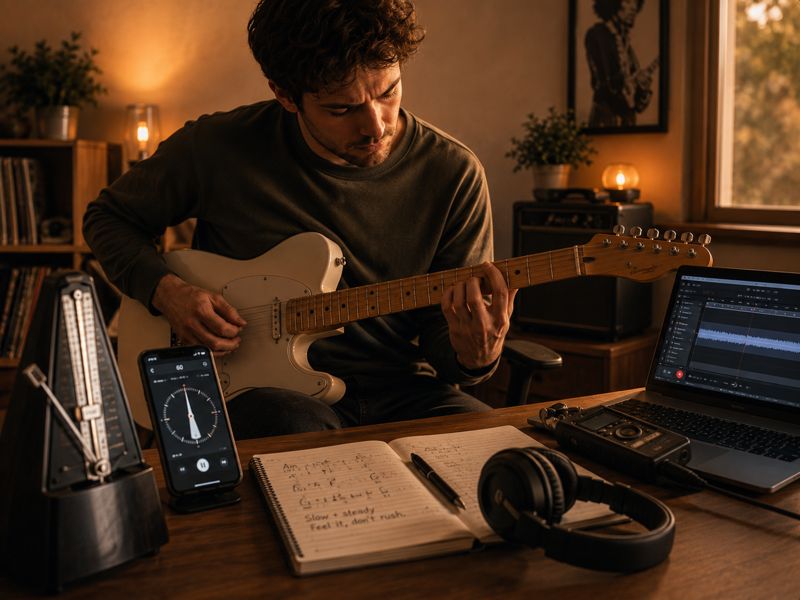
All music is based on rhythm, and most self-taught guitarists have a much less steady internal pulse than they think. The issue is that practising on your own without a metronome or drum accompaniment doesn’t provide you with accurate feedback on how consistently you’re timing. In order to preserve self-image at the expense of realistic self-evaluation, the brain modifies perception to make playing appear more stable than it actually is.
This self-deception is instantly eliminated by recording and listening back. On playback, timing changes that seemed insignificant while playing become apparent. Inconsistent note lengths, drags during chord changes, and rushes during technically challenging passages are all evident in recordings that the playing experience itself disguised.
Timing stability is produced by regular metronome practice at tempos slow enough to execute each note flawlessly; faster, careless practice never achieves this. Most players’ opposition to slow practice stems from a fear of honest appraisal rather than solid evidence that slow work is less valuable.
Avoiding Positions Rather Than Learning Them
Self-taught musicians instinctively gravitate toward the parts of the neck where they feel most at ease, developing repertoire around well-known chord shapes and scale positions while unintentionally avoiding areas that make them feel uneasy. Because the avoided areas never receive the practice that would make them accessible, this results in a continually reinforced comfort zone that gets harder to leave over time.
A guitarist who only employs open-position chords and first-position scales does not explore less of the guitar because these regions are less essential. They avoid the rest because familiarity has never formed there. The connected scale locations that enable melodic movement throughout the entire instrument, the entire upper neck, and the entire variety of chord inversions are still theoretical rather than useful tools.
String Muting as an Afterthought
Active string muting, or the intentional silencing of strings not meant to sound, is necessary for clean playing. Picking and fretting techniques are often developed independently of muting techniques by self-taught musicians, resulting in a playing style that sounds OK on pure tones but becomes obviously sloppy when gain or distortion is added.
The muting process involves both hands. The unused fingers of the fretting hand gently press against nearby strings to stop them from resonating sympathetically. The palm of the picking hand comes into touch with played strings that need to be silenced. These two things don’t just happen. Before they are incorporated into the playing posture, both need intentional development.
Dynamics and the Volume Default
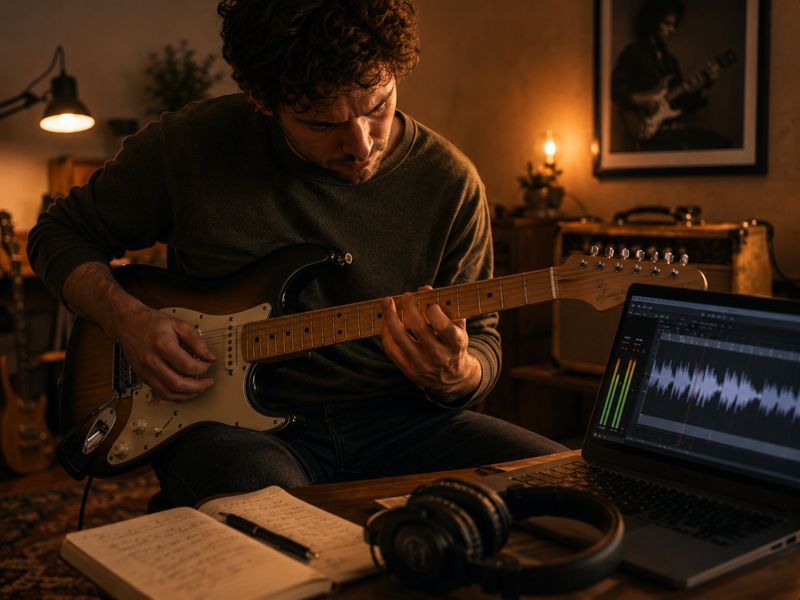
One of the most prevalent and least acknowledged behaviours among self-taught guitarists is playing at a single, constant volume level. The song misses the expressive diversity that separates technically sound but emotionally lifeless performances from captivating playing, with every note receiving roughly the same attack and every passage sitting at around the same intensity.
The development of picking-hand sensitivity that permits gradations between barely touching the string and driving it with full force; the conscious practice of varying pick-attack weight; and the comprehension of which notes within a phrase deserve emphasis, and which serve as connective tissue, all contribute to the emergence of dynamics.
The Practice-Versus-Playing Distinction
Instead of purposefully working on things they are still unable to do, many self-taught guitarists use their practice time to play through things they already know. Because known content flows naturally and the experience is pleasurable, this feels productive. Since no new ability is being developed, its actual developmental worth is negligible.
The gap between present capacity and the next level of competence is the special focus of genuine practice. It entails isolating certain technical difficulties, repeating challenging sections at regulated tempos, and honestly monitoring if the desired talent is truly improving. Playing through favourite tunes is more instantly gratifying than this type of concentrated effort, yet it creates the advancement that enjoyable run-throughs alone cannot.