
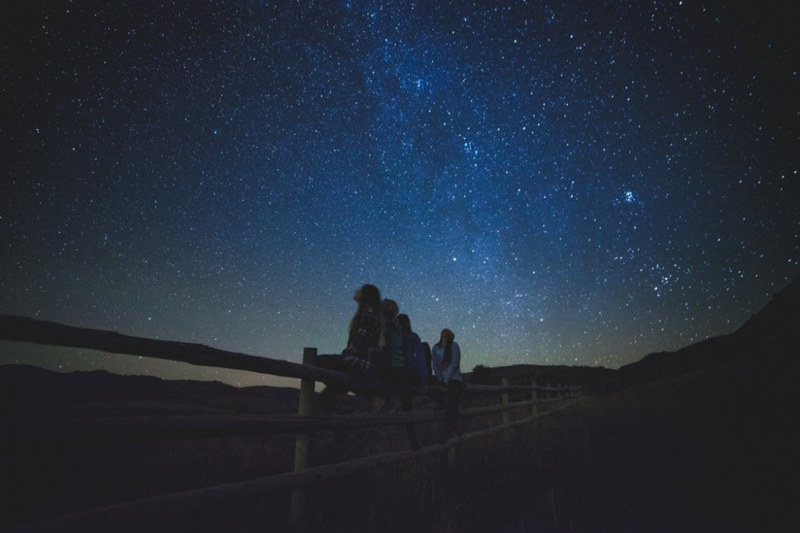
The first time we tried this activity, it went badly. It was a Tuesday in January, around half seven, with three children in wellies in the field behind the church, under what turned out to be total cloud cover. We lasted eleven minutes before the youngest started crying about her hands, and we drove home and had toast instead.
It works now, but only because we stopped treating it as an event. There’s a flask, there’s a blanket, we’re out for about forty minutes, and I promise nobody anything beforehand. Somehow, that has turned it into the thing they suggest on a Saturday when there’s no money and nothing else.
What You Can Actually See Without a Telescope
More than you’d think. Less than the pictures.
Naked eye, clear night: the Plough, Cassiopeia sitting up there like a drunk W, and from about November onwards Orion, with those three belt stars in a row you can’t unsee once you’ve spotted them. Start with those. A child who can find Orion has something to come back to. A child staring at the whole sky at once has nothing.
I’d skip the telescope, at least at first. Ours cost thirty pounds and shook so much that whoever held it couldn’t keep the moon in frame for more than a second or two, and it has been under the stairs since about 2023. Binoculars are better, and if there’s an old pair of 10x50s in a cupboard somewhere, you already own everything you need. Look along the terminator, the line where the lit half of the Moon meets the dark half, and the craters stop looking like a photograph and start looking like holes. Jupiter is the other one worth hunting down: brace your elbows on a fence or a car roof to hold the binoculars steady, and you’ll usually find three or four faint dots strung out beside it in a line. Those are its moons, and Galileo picked out the same ones in 1610 with worse kit than yours, which is a useful fact to have ready when somebody asks why they are standing in a field in the dark.
Two things are worth actually putting in the calendar. The space station goes over as a bright dot travelling in a straight line with no flashing at all, and you can follow it across the sky with a finger; it comes over British gardens several times in most months. Then there are the Perseids, which peak around the 12th of August and are the only meteor shower here warm enough to make staying up sensible. NASA puts out a monthly skywatching guide written for people who don’t own a telescope, and it is honestly the only thing I bother checking.
Get the Night Right Before You Worry About the Place
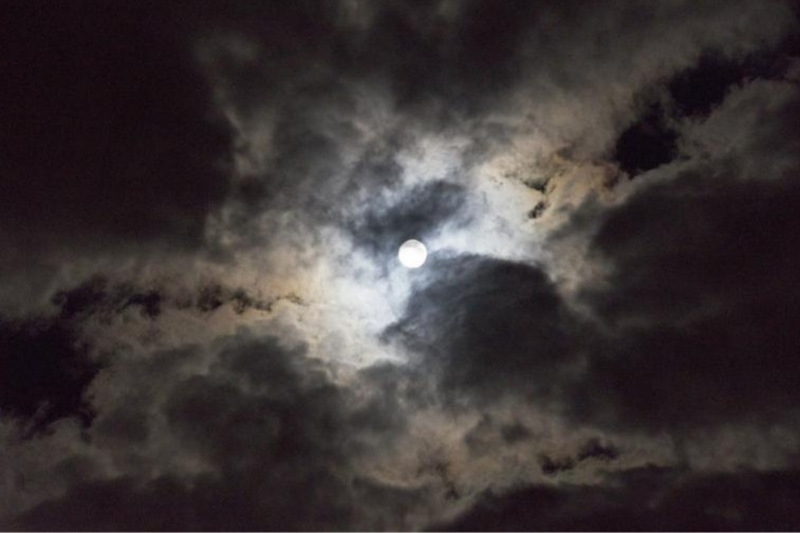
Cloud beats everything. Your back garden under a clear sky will always beat a dark-sky park under an overcast one, and driving further won’t improve the weather. I checked the Met Office cloud cover map the afternoon before. Not the general forecast, that will tell you it’s dry, and it isn’t the same as clear.
The Moon is the other half of the decision, and it took me a while to realize it affects both directions. When it’s full, it drowns out most of what else is up there, so if the Milky Way is the point, you want to be out a few nights after a new moon instead. Craters are the reverse: a half moon wins easily, because the light comes across the surface at an angle and the shadows stretch out behind everything. Whichever you choose, decide before you leave, or you’ll spend the drive discussing it.
Winter’s the season here, for the dull reason that it’s dark by quarter past five. In June you can’t start until they should be in bed. In December we’re out at 5.30 and back before seven, which is the difference between a nice evening and a mistake.
Where to Go
If you want the full version, there’s a proper dark sky in this country, with the Milky Way genuinely overhead rather than implied. Northumberland National Park and Kielder, alongside it, make up one of the largest areas of protected night sky in Europe, and the observatory at Kielder runs evening sessions you can book, with real telescopes and somebody who knows what they’re aimed at. Exmoor got there earliest, as Europe’s first International Dark Sky Reserve. Up in Scotland, Galloway Forest Park has viewing points you can park beside, which sounds like a trivial detail until you are getting three children and a flask out of a car in complete darkness.
Further south, there is Exmoor, as above, plus the Brecon Beacons (Bannau Brycheiniog) in Wales and the South Downs, both dark-sky reserves within reach of many people. To find somewhere closer to home, the CPRE and Go Stargazing both publish maps of England and Wales shaded by how dark the sky actually is, which is the quickest way to see how far you would really need to drive.
But for your first go? Fifteen minutes from your front door. You’re not after wilderness. You’re after a hedge or a wall between you and the nearest streetlight and a clear view low down to the south. A cricket pitch does it. So does the far end of a park or a village car park. Two hours in the car gains you a better sky and loses you the child, and the child is the point.
What to Take
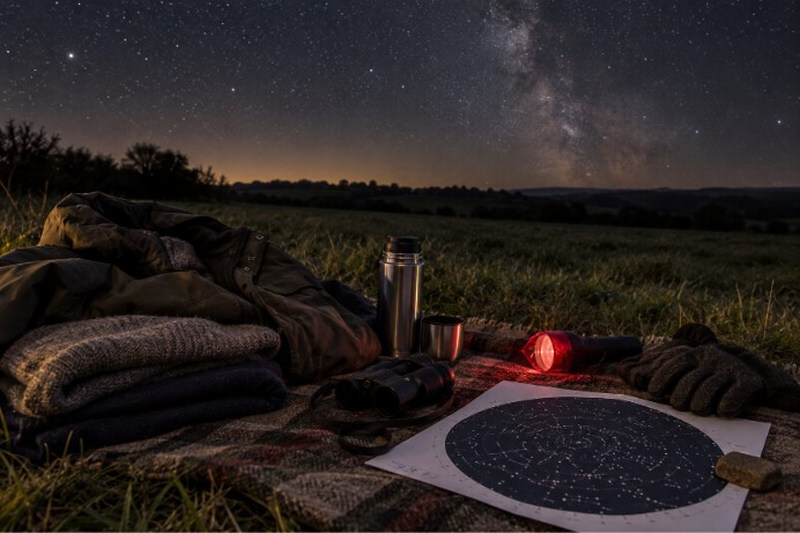
Take more layers than the temperature suggests, because standing about in a field is a good deal colder than walking through one, and that has caught me out twice now. Something hot in a flask, though I’ve come to think the flask matters less for the drink than for giving everyone something to do with their hands.
A torch with red cellophane taped over the front, or a proper red one if you’re buying, since white light resets everybody’s night vision the moment somebody drops a glove. Binoculars, if they’re already in the house. And print the star chart, because as soon as a phone comes on at full brightness, nobody standing nearby can see anything for the next few minutes.
When They Ask What Their Star Sign Is
They will. Ours managed it in about eight minutes, somewhere between Orion and “Is that one a planet or a plane?”
Have something ready, because the answer underneath is genuinely useful. Where the planets are is just arithmetic. You can work it out for 2040, then check it against a published astronomical table to see how close you got. What those positions are supposed to say about a person is a different kind of thing altogether. Someone typing is Nebula legit into Google is really asking two questions in one breath — is the maths right, and does the reading on top of it mean anything — and they’ve got very different answers. A field with a star map is a good place to make that distinction, because out there the astronomy is the half you can check for yourself.
Stop Before You Want To
Forty minutes, tops. Two constellations, the Moon through the binoculars, drink the hot chocolate, home.
The temptation, when the cloud finally clears at nine, is to stay and get your money’s worth. Don’t. That’s how a good night becomes the reason nobody comes next time. Same lesson we learned on a day out around Ribblehead — the trip everyone remembers fondly is the one we cut short.
One thing to do this week: look up the Moon phase for the next fortnight and pick your night off that, instead of whichever evening you happen to be free. Everything else you can just wing.