
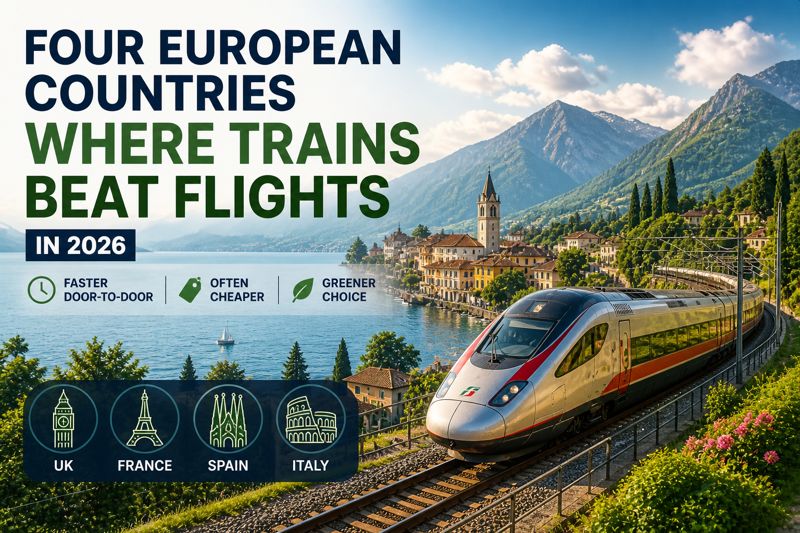
The way we travel across Europe is changing as airport security and remote terminals shift the maths in favour of rail. In 2026, the train is often the fastest door-to-door option for short-haul trips because you can avoid liquid restrictions, security lines, and luggage carousels.
As networks modernise, the travel time gap between air and rail continues to close. There’s a lot to unpack here regarding time and cost, so we’ll walk you through it to help you plan your next trip.
Real Door-to-Door Speed on the UK East Coast Main Line
The route between London and Edinburgh is the ultimate test of rail versus air. While an 80-minute flight seems fast, it’s misleading once you factor in the trek to the airport and long security queues. By the time you add those hours up, you’re looking at a total travel time of well over five hours. A direct train from King’s Cross takes around four hours and twenty minutes, landing you in the heart of the city instead of the outskirts. This saves time and avoids the stress of airport transfers.
Cost is also a major factor since budget airlines charge extra for bags and seat selection, especially on longer routes across the UK. Right now split ticketing is your best bet in finding the best fare for London to Edinburgh. This method involves buying separate tickets for different stages of the journey, which can bring the price down significantly compared to a standard fare. On top of the savings, the train provides a relaxed space to work or enjoy the views of the Northumberland coast.
Efficient, High-Speed Connections in France
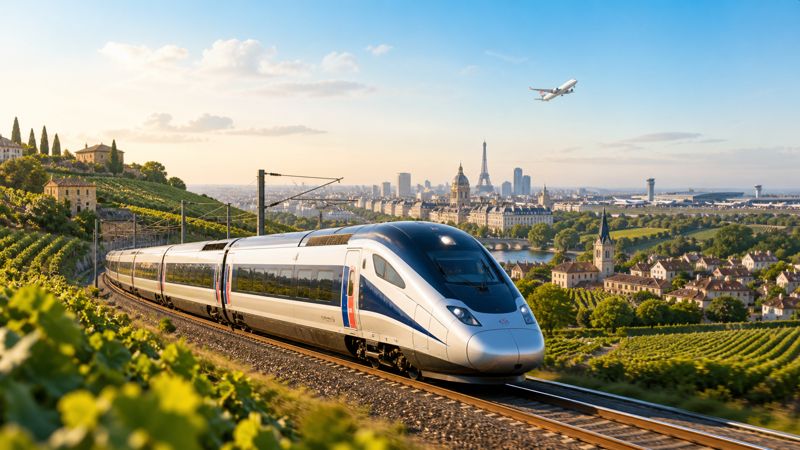
France’s high-speed rail network is one of the strongest arguments against short-haul flying in Europe. The country has already banned several domestic flights where a train alternative exists in under two and a half hours, a clear sign of how competitive the rails have become. Routes like Paris to Lyon or Paris to Marseille are faster door-to-door than flying once you factor in the trek out to Charles de Gaulle and the security queues at the other end.
Watching the French countryside pass by is far better than sitting in a cramped middle seat on a plane. You will have more legroom and the freedom to walk to the buffet car whenever you like. Using the train is a civilised way to travel that ensures you arrive feeling refreshed. It is also more productive because the on-board Wi-Fi actually works for the entire journey.
Competitive High-Speed Rail in Spain
Spain’s investment in its AVE high-speed network has made the Madrid to Barcelona route more efficient than flying, covering the distance in about two and a half hours. With several operators competing, rail fares are often cheaper than budget flights or buses. The experience stands out because stations are in city centres, boarding is fast, and punctuality remains world-class. We’ve listed a few things below that make the Spanish rail experience stand out:
- Stations are located in city centres, saving you expensive taxi fares from distant airports.
- Boarding is very quick and only requires a brief luggage scan rather than a full security pat-down.
- Punctuality rates for these high-speed lines are among the best in the world.
- You can carry more luggage without paying the per-kilo fees that airlines love to charge.
Rapid Transit for the Italian North-South Route
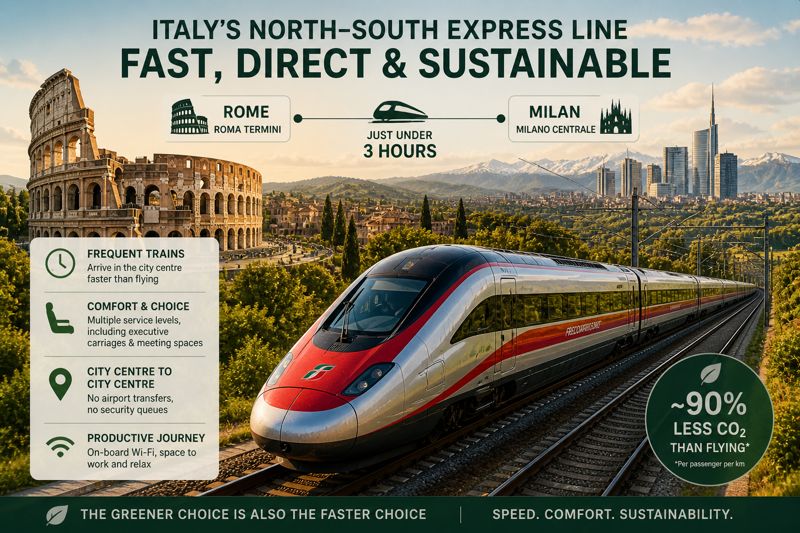
Italy’s north-south express line is a prime example of rail dominance, with the Rome to Milan journey taking just under three hours. Since trains run so frequently, you can arrive at Roma Termini and reach central Milan before a flyer even clears security at Fiumicino. The system offers various service levels, from standard to executive carriages with meeting spaces. It is a direct and reliable way to see the country without the stress of airport transfers.
On top of the speed, the environmental impact is much lower as the train produces about 90% less CO2 than a flight. For many travellers in 2026, this lower footprint is a major deciding factor. You don’t have to sacrifice speed to be sustainable because the greener choice is also the faster one on this route.
In a Nutshell
Choosing between the train and a flight often comes down to looking at the total travel time rather than just the time in the air. In countries like the UK, France, Spain, and Italy, the infrastructure is now so advanced that the rails are the logical choice.
You’ll save yourself the headache of airport queues and often save a decent amount of money by using clever ticketing methods. Next time you plan a trip across Europe, check the train times first. You’ll likely find they beat the flight in every way that matters.