
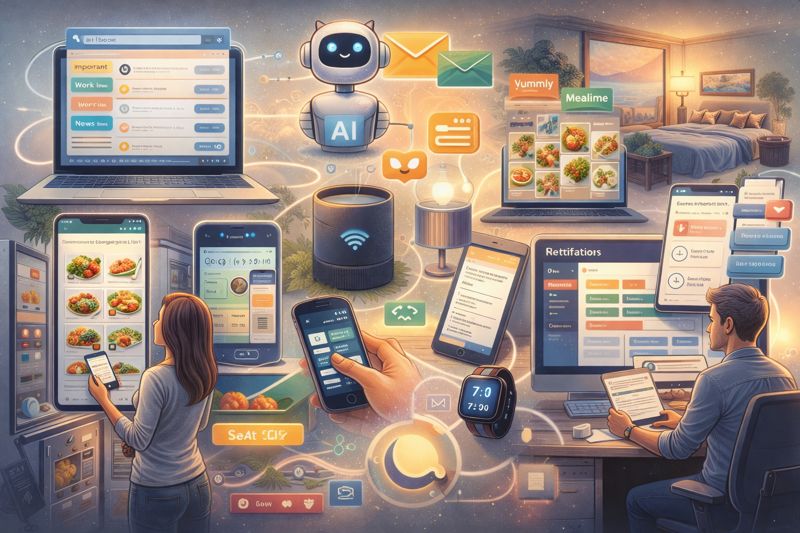
Most people think of AI as something complicated. A tech thing. Not for them. But here’s the truth: daily AI hacks are already reshaping how millions of ordinary people handle the most boring parts of their day — and most of them don’t even realize it.
According to McKinsey, workers spend nearly 28% of their workweek managing email alone. That’s more than a full day. Gone. Every single week.
Tame the Email Monster
An AI personal assistant can organize email inboxes automatically — sorting newsletters from urgent messages, flagging what actually matters, and archiving the rest without you touching a thing. It learns your habits. Quietly. Over time, it gets eerily good at knowing what you care about.
Some tools even draft quick responses for you based on the email’s content. You read three sentences, click approve, done. What used to take 20 minutes now takes 45 seconds.
You Don’t Have to Think About Dinner Anymore

Meal planning sounds simple. It isn’t. You have to think about nutrition, budget, what’s already in the fridge, who’s eating what, and whether Tuesday is a busy night. AI can generate meal plans tailored to all of that — in seconds.
Apps like Yummly and Mealime use AI to build weekly plans and then automatically manage grocery lists based on what you’ve chosen. No duplicates. No forgotten items. One less thing living in your head.
Easy Math Problem Solving

Have a problem with numbers? Well, everyone has one, and if you dig deeper, it happens every day. Next time you’re wondering how to solve your Google Math problem, just use an AI solver.
The Math AI Extension for Chrome is a great option. The AI will perform the calculations, provide a step-by-step solution, and give you the exact answer instead of trying to remember and solve the problem. This is also useful for learning.
Reading Without Actually Reading Everything
There’s too much to read. It always has been, but now it’s worse. Long reports, news threads, research papers, endless blog posts. The average adult reads about 200–250 words per minute — a 10-minute article takes real time and real focus.
AI tools can summarize long articles into three bullet points or a short paragraph. The key idea. The conclusion. What you actually need. Some browser extensions do it with one click, right on the page.
Your Home, Running Itself
Lifestyle automation used to mean a fancy timer on your coffee maker. Now it means something completely different. AI-powered smart home systems learn when you wake up, when you leave, when you’re usually cold, when the kids get home.
The lights adjust. The thermostat shifts before you even walk through the door. According to the U.S. Department of Energy, smart thermostats alone can save homeowners up to 10–12% on heating and 15% on cooling annually. The system just… handles it.
A Calendar That Actually Works With You
Manually schedule calendar events and you’ll spend 15 minutes going back and forth on a meeting that takes 30. AI scheduling tools like Reclaim or Motion analyze your calendar, your priorities, and your working style — then block time automatically.
They protect your deep work hours. They reschedule low-priority tasks when something urgent appears. Your week starts to look like something a very organized person planned. That person is the algorithm. It’s a small shift, but one that reflects a bigger move toward smarter routines—something that can even reset your family routine.
Sleep Better. Seriously.

This one surprises people. AI can optimize sleep patterns by analyzing data from wearables — your heart rate, movement, breathing patterns — and giving you specific, personalized recommendations. Not generic advice. Your data, your patterns, your fixes.
A 2025 study published in npj Digital Medicine found that AI-driven sleep coaching led to measurable improvements in sleep quality within just two weeks. Go to bed 20 minutes earlier. Cut the screen at 9:45. Tiny shifts. Real results.
The Grocery List That Writes Itself
You run out of olive oil. Again. You forget oat milk. Every time. AI tools integrated with smart home devices or apps can track what you use and when, then manage grocery lists automatically — adding items before you even notice they’re low.
Some systems connect directly to delivery apps. The item disappears from your shelf, reappears in your cart. It feels almost too easy. It is that easy.
Responding Faster Without Thinking Harder
Whether it’s a work Slack message, a friend’s long text, or a client email — AI can draft quick responses based on context. You read what they wrote. The AI suggests three possible replies. You pick one, tweak a word, send.
Studies from Stanford have shown that AI writing assistance can reduce response time by up to 40% without reducing quality. You stay present in conversations without getting buried by them.
The Bigger Picture
None of these tools replace you. That’s not the point. The point is attention — your most limited resource. Every task that gets automated, summarized, scheduled, or simplified gives you back a little bit of it.
An AI personal assistant doesn’t make your life perfect. It makes the boring parts smaller. And sometimes, that’s exactly enough.