
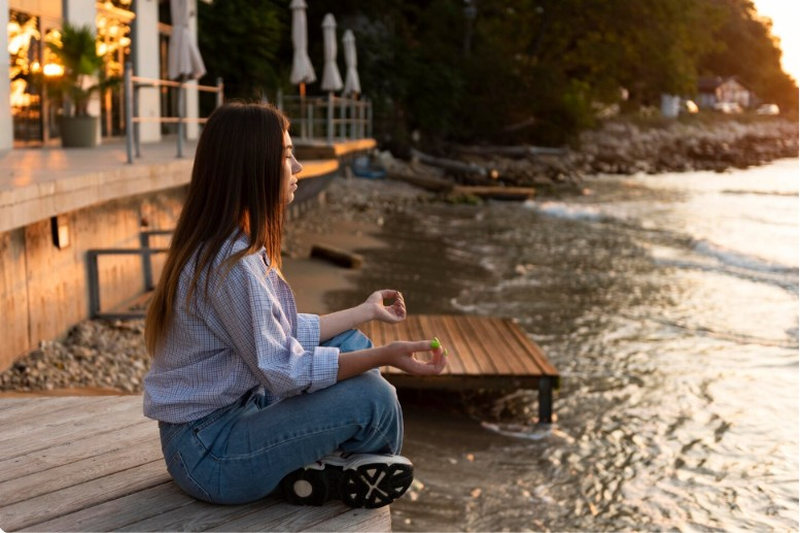
Most people spend part of every evening replaying their day: what went wrong, what was said, and what’s still undone.
The mind circles, but circling is not the same as reflecting, though it can feel convincingly similar.
That gap between the two, small as it seems, matters considerably for how you feel over time.
How Reflection Differs From Ordinary Thinking
Rumination runs on autopilot. You find yourself halfway through dinner, revisiting a conversation from Tuesday, adding nothing new, and resolving nothing. Reflection, though, is deliberate, as it asks a question rather than circling an answer it already thinks it knows.
The act of bringing structure to your mental processing. Noticing what drained you, what surprised you, and what felt off can interrupt a cycle of background anxiety that never resolves on its own. Even five minutes of intentional review shifts your position from passenger to observer. That change in perspective is where the benefit begins.
Some people build that structure through journaling or a walk without their phone. Others use apps that offer daily prompts or astrology-based check-ins. If you’ve ever wondered is Nebula astrology worth it, particularly as a self-reflection tool, it’s worth taking a closer look. The value in those apps usually has little to do with the predictions themselves. The value comes from the habit of pausing.
What Self-Reflection Does for Mental Well-Being

The connection between reflection and mental health shows up in observable changes in how you process experience. When you observe your own reactions and patterns, you start to build emotional regulation: the ability to recognise a feeling, understand where it came from, and decide how to respond.
Over time, many people report feeling better able to understand and respond to challenging situations. A difficult conversation at work stops being just a bad day and becomes data you can act on. You notice that you feel worse after some activities and better after others. Small patterns become visible that would otherwise be invisible inside the busyness of a normal week. That awareness doesn’t remove difficulty, but it gives you something to work with. That may sound like a modest benefit, but it changes the texture of how hard stretches feel.
Regular reflective practices may help reduce ruminative thinking for some people, particularly when reflection is structured and solution-focused rather than repetitive. The charity Mind has practical guidance on how habits like reflection support mental well-being, particularly during periods of accumulated stress.
For some individuals, particularly those prone to anxiety or rumination, reflection is most helpful when it is structured and focused on learning or problem-solving rather than repeatedly revisiting distressing events.
The Common Barriers to Reflection
Most people agree that pausing to think sounds reasonable. Few do it consistently. The most common barriers are:
- Time. Reflection feels like something for when everything else is finished, which means it never happens.
- Perfectionism. Journaling especially attracts the idea that it needs to be done properly or not at all.
- Discomfort. Sitting with your own thoughts can surface feelings you’d rather avoid, especially early on.
Each matters, but each softens with a simpler format. You do not need thirty minutes or a beautifully kept notebook. You need a repeated moment at the same time each day, low-pressure, brief enough that skipping it starts to feel like the odd choice. The simpler the format, the more likely it is to survive a demanding week.
Practical Ways to Make Reflection a Habit

Regularity is the goal, ahead of insight. A consistent two-minute check-in does more over a month than an occasional hour spent thinking things through.
A few approaches that tend to work:
- End-of-day questions. Three short prompts each evening: what went well, what was hard, and what you want to carry forward. Takes under five minutes.
- Morning intention. One sentence written before you check your phone. Where do you want your attention to go today?
- Verbal reflection. Talking briefly through your day with a partner or friend. Spoken reflection often surfaces things that written reflection misses.
- Themed periods. Focus on one area of life per week—sleep, work, relationships—and reflect through that lens.
You do not need to use all of these at once. Starting with one format and staying with it until it no longer requires effort is more useful than cycling through approaches. The format matters less than the consistency.
Reflection as Part of a Wider Well-Being Routine
Daily reflection works best when it sits alongside other habits, such as sleep, movement, and connection, rather than substituting for them. It is one practice among many, but it is the practice that makes the others more legible. Reflection also acts as a kind of running log, not for productivity, but for mood and energy over time.
When you pay attention to what affects your mood and energy, a feedback loop forms. You notice that you sleep worse after scrolling before bed. You see that some work patterns leave you flat by Thursday. You catch the early signs of accumulating stress rather than meeting them mid-week, when they’ve already built up into something harder to shift.
Reflection may help some people recognise stress earlier and respond to it more effectively. Over time, that changes both how the weeks tend to go and how you enter the next one.