
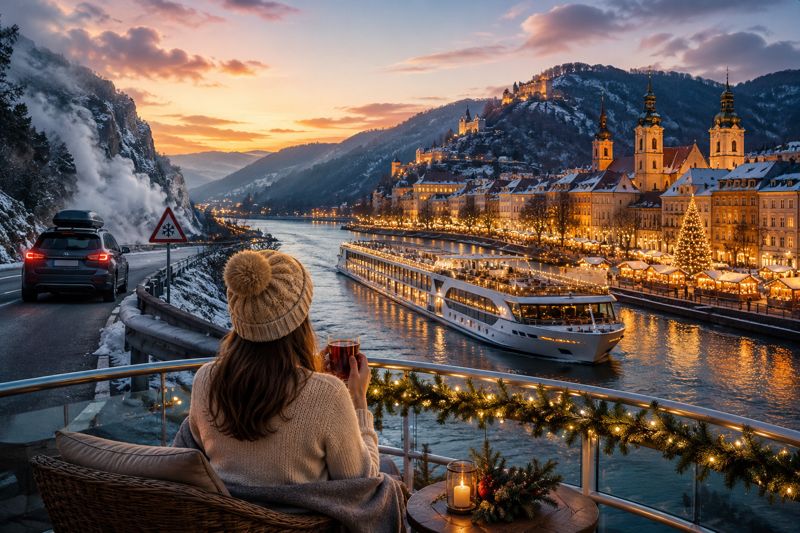
Winter travel promises festive markets, snow-dusted city squares, and the kind of atmosphere that only December can deliver. But how you get between those destinations shapes the entire experience. Two formats dominate winter travel planning: the multi-city road trip and the river cruise. Both can cover similar ground. Only one does it without making you feel like a logistics coordinator.
For travellers who want to see multiple destinations without the planning friction that follows, a floating holiday consistently delivers more value, more rest, and more actual enjoyment per day than a road trip across the same region.
The Hidden Costs of a Multi-City Road Trip
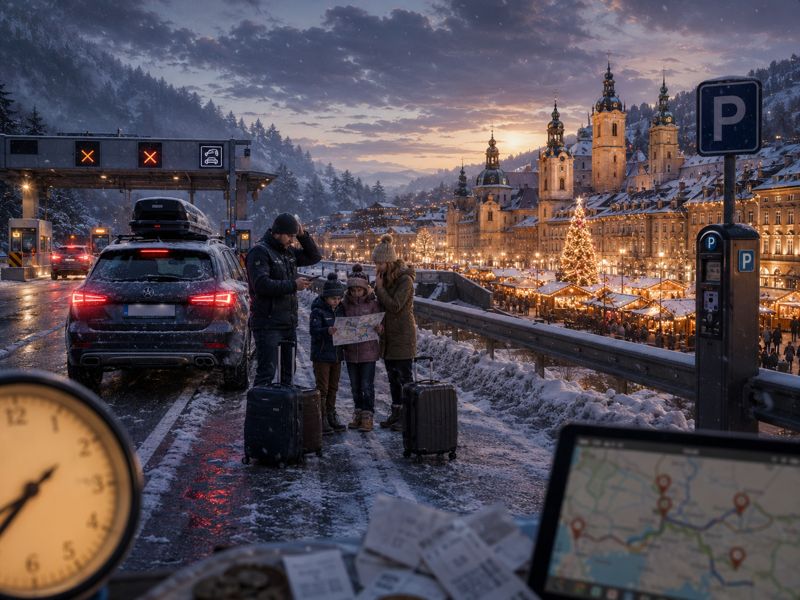
Road trips carry an appeal that is easy to romanticize. Open roads, flexible schedules, and the freedom to stop wherever you choose. In practice, winter road trips in Europe or North America add layers of cost and complexity that most travellers underestimate at the planning stage.
What Road Trippers Actually Spend
Fuel is the obvious expense, but it is rarely the largest one once the full trip is tallied. Tolls accumulate quickly on European motorways. Parking in historic city centres, precisely where Christmas markets are located, can cost as much as a restaurant meal per day. Hotel rates spike during the festive season, and booking separate properties in each city means paying premium rates across multiple stays rather than locking in one competitive price.
Beyond the financial picture, time itself becomes a cost. Hours spent driving between cities are hours not spent at a market stall, inside a cathedral, or at a riverside terrace with mulled wine. A four-hour drive between two market cities is half a travel day gone before the first gluhwein is poured.
The Winter Road Condition Variable
Summer road trips carry their own inconveniences. Winter road trips carry genuine risk. Ice, reduced visibility, and sudden weather changes introduce a safety variable that does not exist in warm-season travel. Even experienced drivers operating modern vehicles face the reality that a snowstorm can close a mountain pass, delay a border crossing, or turn a two-hour drive into a five-hour ordeal.
Travel insurance rarely covers self-inflicted delays caused by weather decisions. When a road tripper decides to push through poor conditions and misses a planned market or pre-booked restaurant, there is no crew to call and no contingency built into the itinerary.
What Stress-Free Actually Means on a River Cruise

The phrase stress-free travel gets used loosely in tourism marketing. On a river cruise, it has a specific structural meaning that goes beyond comfortable beds and good food.
You Unpack Once
This single fact changes the entire psychology of multi-destination travel. On a road trip covering six cities, a traveller packs and unpacks six times, checks in and out of multiple properties, and carries the mental load of knowing where everything is supposed to be at every stage. On a river cruise, luggage goes into the cabin on day one and stays there until the final morning.
The ship moves while passengers sleep. Travelers go to bed in one city and wake up in another, with breakfast already being prepared and the morning’s shore excursion briefed the night before. That rhythm, repeated across a week or two, creates a quality of rest that fragmented hotel stays cannot match.
Decision Fatigue Is Removed Without Removing Choice
One of the quieter forms of travel stress is the constant stream of small decisions: where to eat tonight, which route to take tomorrow, whether the weather justifies the detour. River cruises operate on a fixed daily structure that eliminates most of those micro-decisions without removing genuine flexibility.
Shore excursions are planned and briefed in advance. Meals are prepared onboard. Port schedules are set. Travelers can follow the structured day or spend time independently at each stop. What they do not have to do is start every morning by rebuilding the plan from scratch.
- Onboard staff manage port logistics, tender schedules, and excursion timing
- Dining options are available without requiring a reservation or a search
- Evening entertainment and programming require no additional planning or spending
- Weather contingencies are handled at the operational level, not by the traveller
The Christmas Market Advantage of River Routes
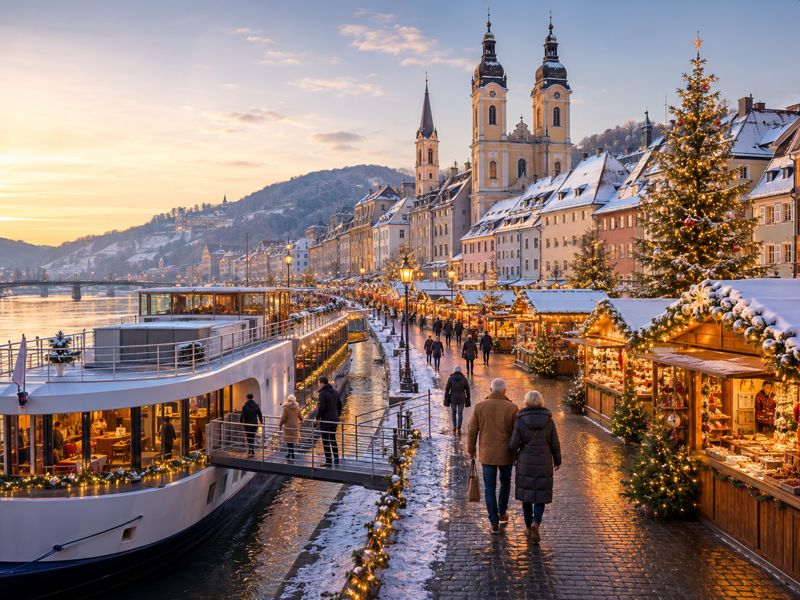
Christmas markets are not randomly distributed across European cities. They cluster along river valleys, particularly the Rhine, the Danube, and the Moselle. Nuremberg, Vienna, Strasbourg, Cologne, Budapest, and Regensburg are all river cities. This is not a coincidence. These cities developed along trade routes that followed waterways, and their markets grew from that same commercial tradition.
Road trippers attempting to connect these cities face a geometry problem. The most efficient road routes between them do not always follow the river, meaning drivers often travel inland and then return to the water at each stop. The driving time between Strasbourg and Cologne by road is roughly two hours under good conditions. In December, good conditions are not guaranteed.
River Cruises Are Built Around Market Clusters
A river cruise itinerary along the Rhine or Danube is designed to thread through market cities in geographic sequence. The vessel docks in the center of each city, often within walking distance of the main market square. Travelers step off the gangway and walk directly into the festive atmosphere rather than navigating from a remote car park on the city outskirts.
For travellers planning a festive European trip, booking a dedicated Christmas market river cruise places multiple top-tier markets within a single itinerary, removing the need to coordinate separate city stays, hotels, and driving legs across the region.
Market opening hours and peak crowd times are also factored into the shore excursion schedule. Cruise guests often arrive at markets during quieter morning hours before day-trippers and road-based tour groups arrive, which is a meaningful advantage during the December peak period.
The Social and Mental Load of Each Format
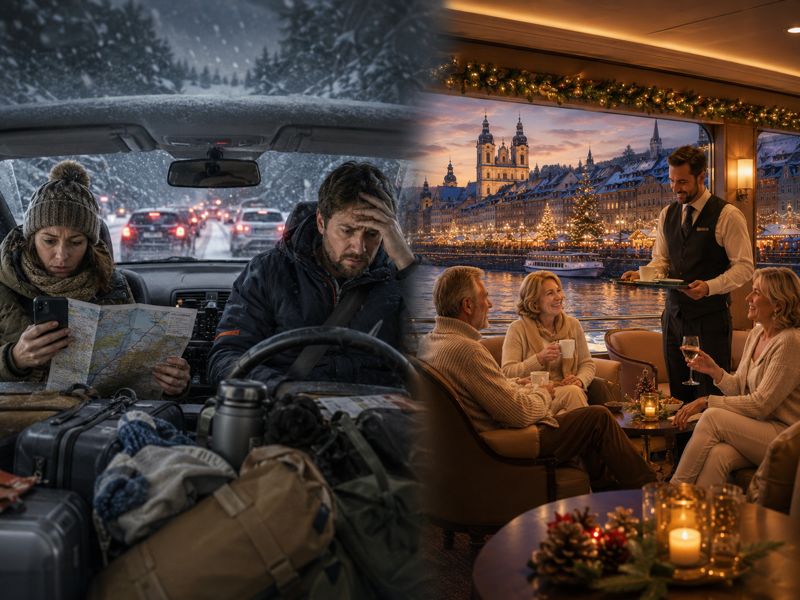
Travel is rarely a solo cognitive exercise. Even when traveling alone, the mental energy required to manage a multi-city road trip is substantial. When traveling with a group, that load concentrates on whoever is driving and navigating, while other group members have limited ability to contribute meaningfully.
Road Trips Concentrate Responsibility
On a multi-city road trip, one or two people carry the weight of every logistical decision. The driver manages road conditions and navigation. The co-pilot manages maps, timings, and accommodation confirmations. Everyone else waits. That dynamic creates an imbalance that can build tension across a week-long trip, particularly when weather or traffic introduces stress into an already full schedule.
River cruises distribute that responsibility entirely to a professional crew. The captain navigates. The program manager plans shore excursions. The onboard team handles meals, cabin service, and daily logistics. Travelers arrive as guests rather than project managers.
Group Travel Works Differently Onboard
For families, couples traveling together, or friend groups, the shared spaces on a river cruise create social opportunities that a car simply cannot. Common lounges, dining rooms, and deck areas allow group members to come together or find their own space without the physical constraint of a vehicle interior.
Evenings onboard offer genuine rest. There is no dinner search, no parking situation to resolve, no check-in queue at a new hotel. The evening meal is available, the cabin is ready, and the next morning’s plan is already set. That consistency compounds across the length of the trip into something that feels meaningfully different from a road itinerary of similar duration.
Conclusion
Multi-city road trips offer autonomy, and that appeals to a specific kind of traveller. But autonomy in winter conditions, across multiple city-center hotel bookings, with the full logistical weight of each day sitting on one or two people, has a real cost measured in stress, time, and money.
River cruises trade a degree of scheduling flexibility for a significantly lower daily cognitive load, a more complete experience at each destination, and a structural fit with how Christmas market cities are actually arranged across European river valleys.
For travellers whose priority is maximum destinations with minimum friction, the floating holiday is not simply a more comfortable option. It is a more rational one.