

There is a quiet frustration growing among parents across the UK and the US alike. Despite years of schooling, children are leaving classrooms without a working understanding of how money operates, how economies function, or what personal financial responsibility actually looks like in practice. For many families, this gap feels less like an oversight and more like a design flaw. The good news is that filling it does not require a teaching degree or a complete overhaul of your family’s routine.
The Gap Between School and Real-World Readiness
Most national curricula treat economics as a subject reserved for older secondary students, and even then, it tends to focus on abstract theory rather than practical application. Children learn about the water cycle, photosynthesis, and the causes of historical wars, but rarely do they learn how supply and demand affect the price of the cereal in their kitchen cupboard, or why inflation means their pocket money buys less than it used to.
This is not a small problem. According to data from Tuttle Twins, a US-based educational publisher, 90% of parents who supplement their children’s education do so specifically because they do not feel confident that traditional schools are preparing their children for real-world success. That figure spans public- and private-school families alike, and it points to something many parents already sense but rarely say out loud: the classroom, on its own, is not enough.
Story-Based Learning as a Foundation for Economic Thinking
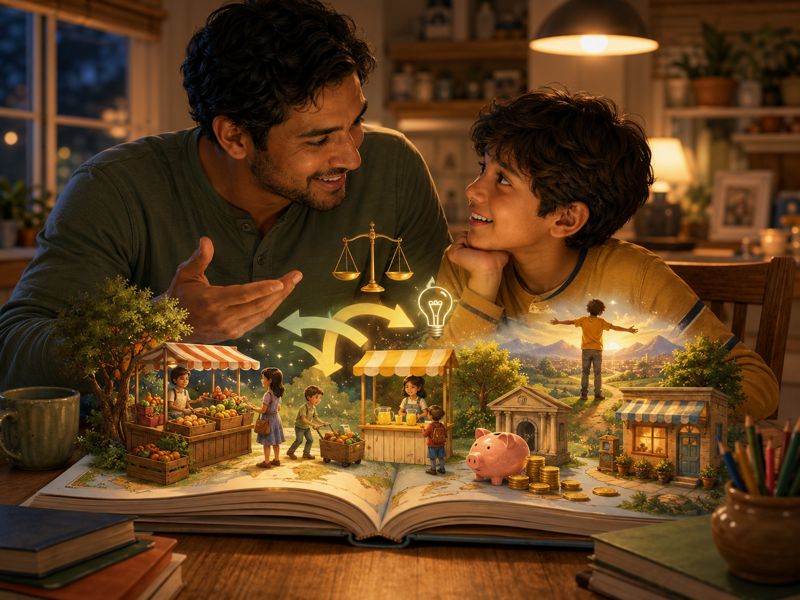
One of the most effective ways to introduce complex ideas to children is through story. When a concept is embedded in a narrative, with characters facing real consequences and making meaningful choices, children retain it far more readily than they would from a textbook definition.
This is the principle behind some of the most successful educational materials currently available for home and after-school use. The Tuttle Twins book series, for example, is built on the ideas of economists and thinkers including Ludwig von Mises, Frédéric Bastiat, and F.A. Hayek, but presents those ideas through accessible, age-appropriate stories that children actually want to read. For parents who want to explore this approach in more depth, search Tuttle Twins online for resources to build out a curriculum around these principles, whether you are homeschooling full-time or simply looking to supplement what school provides.
The strength of story-based learning is its ability to spark conversation. Many parents using these materials report what the brand calls “Dinner Table Moments,” discussions that arise naturally from the stories their children have read, covering topics like trade, taxation, liberty, and entrepreneurship. These conversations are not forced or academic. They emerge because the child already has a frame of reference, a character they liked, a dilemma that stuck with them.
Building a Curriculum Around Liberty and Critical Thinking
If you want to build a home learning environment that goes beyond the standard curriculum, the subject of liberty is a surprisingly rich place to start. Understanding individual rights, the role of government, and the responsibilities that come with freedom are not partisan topics. They are foundational ideas that equip children to engage thoughtfully with the world around them.
A simple starting point is to introduce your child to the Founding Fathers, not just as historical figures but as thinkers who wrestled with genuinely difficult questions about how societies should be organised. Connecting those ideas to present-day situations, such as school rules, family decisions, or news stories they encounter, helps children see philosophy as something living rather than historical.
For families with children across a wide age range, one of the practical challenges is finding materials that work at different levels simultaneously. A well-structured curriculum resource will typically offer content tiered by age group, so a nine-year-old and a fourteen-year-old can both learn the same core ideas without one being bored and the other feeling lost.
After-School Enrichment Without the Overwhelm
Not every family that wants to do more is in a position to homeschool. Many parents are working full-time while also trying to be intentional about what their children are absorbing outside of school hours. The idea of “building a curriculum” can sound daunting when you are already managing homework, activities, and the general chaos of family life.
The practical reality is that enrichment need not be formal to be effective. Even thirty minutes a week of focused, values-driven reading and discussion can shift the trajectory of a child’s thinking about the world. A well-chosen book, followed by a few open-ended questions at dinner, can do more for a child’s economic literacy than a semester of abstract classroom instruction.
When selecting resources, it helps to look for materials that meet a few simple criteria. They should be engaging enough that children choose them willingly. They should introduce ideas with enough depth to be meaningful, but without so much jargon that they alienate a young reader. And they should provide a natural hook for family discussion, rather than being something a child simply reads and puts down.
Choosing Resources That Grow With Your Child
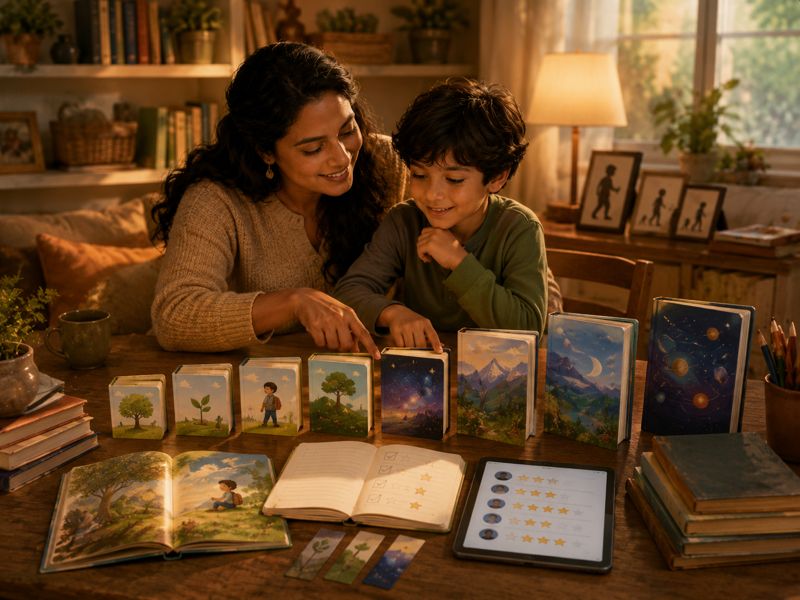
One of the most common mistakes parents make when building a home learning library is choosing resources that only work for one age group. Children grow quickly, and a book that captivates a seven-year-old will not hold the attention of the same child at twelve. Investing in a series or a curriculum that spans multiple developmental stages is both more economical and more effective.
It is also worth considering what values are woven into the materials you choose. Books and educational resources are not neutral. Every story makes implicit arguments about what matters, what kind of behaviour is admirable, and what a good life looks like. Being intentional about those choices is part of thoughtful parenting, regardless of whether your children attend traditional school.
Practical steps for getting started include browsing curated resource lists from trusted educational communities, looking for materials with strong parent reviews from families with similar values, and starting small rather than trying to overhaul everything at once. A single great book, read together and talked about honestly, is a far better starting point than an elaborate plan that never quite gets off the ground.
Conclusion
The families who tend to see the strongest results are not necessarily the ones who spend the most or plan the most meticulously. They are the ones who stay curious alongside their children, ask good questions, and treat learning as something that happens at the kitchen table as much as at a school desk.F