
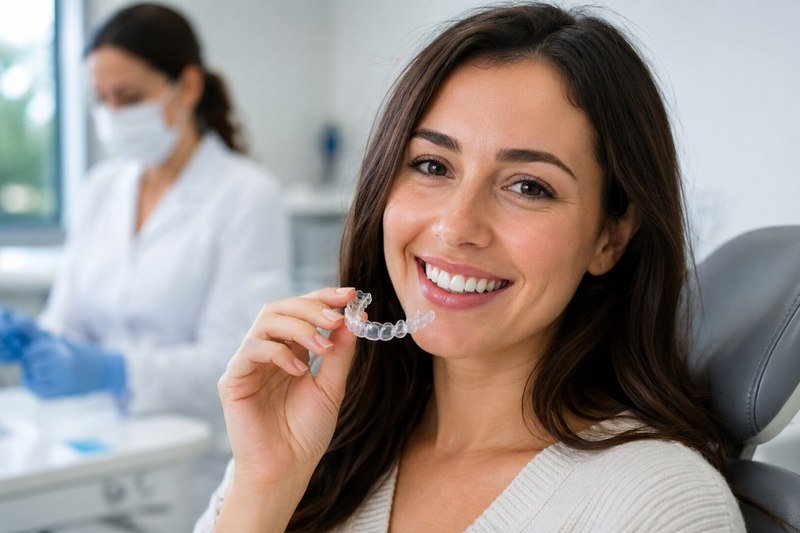
The landscape of orthodontics has transformed dramatically over the last two decades. There was a time when correcting a severely misaligned smile automatically meant enduring a long, conspicuous journey with traditional metal train-track braces. Today, clear aligners are the treatment of choice for millions of people worldwide seeking a more discreet, comfortable, and lifestyle-friendly path to straight teeth.
However, as the popularity of clear aligners has soared, so too has the debate surrounding their capabilities. While their efficacy in correcting mild aesthetic crowding or closing small gaps is undisputed, a critical question remains for many patients: Can clear aligners successfully fix complex dental overcrowding and severe bite issues?
If you have been told in the past that your orthodontic issues are “too severe” for clear trays, or if you are trying to navigate the conflicting information online, this comprehensive guide will break down the science, the limitations, and the modern advancements of clear aligners from Bright Orthodontics.
The Mechanics: How Clear Aligners Work
To understand whether aligners can tackle complex cases, it helps to understand how they move teeth. Unlike traditional fixed braces, which use high-tension brackets and archwires to actively pull teeth into alignment, clear aligners use a series of custom-moulded, medical-grade plastic trays to gently push teeth into position.
Each aligner in your series is designed to move your teeth a fraction of a millimetre at a time. Every one to two weeks, you progress to the next set of trays, gradually moving your smile closer to its final, optimal position.
Historically, this “pushing” motion meant that clear aligners were structurally limited. They struggled with complex bodily movements of the teeth, such as rotating cylindrical bicuspids or pulling deeply impacted teeth down into the dental arch. However, the introduction of smart engineering features has completely changed the game.
Overcoming Complexity: The Role of Attachments and Elastics
The secret behind the modern clear aligner’s ability to treat complex overcrowding and malocclusions (bite issues) lies in the use of auxiliary orthodontic components.
1. SmartForce Attachments
If you require complex movements, your treatment will likely include “attachments”. These are tiny, tooth-coloured composite resin dots that are temporarily bonded to your teeth before your treatment begins.
They act as tiny handles or anchors. When your aligner snaps over the attachments, the plastic has a geometric surface to push against. This allows the system to achieve highly precise, complex movements, such as severe tooth rotation or root uprighting, that would be impossible with smooth plastic alone.
2. Orthodontic Elastics (Rubber Bands)
Many patients associate rubber bands strictly with metal braces, but they are now heavily integrated into complex clear aligner treatments. By clipping small elastics onto precisely cut notches in your top and bottom aligners, your orthodontist can apply the continuous, diagonal force required to shift your entire jaw forward or backwards, treating deep overbites, underbites, and crossbites.
Can Clear Aligners Fix Severe Overcrowding?
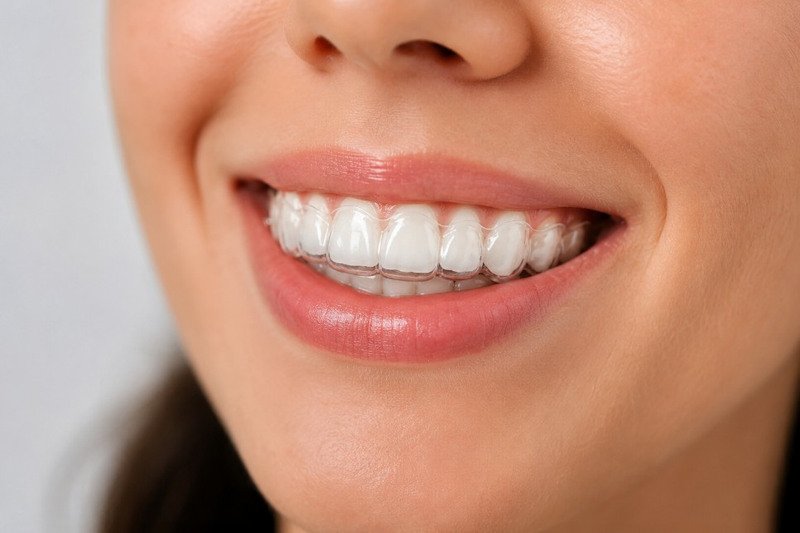
Severe dental overcrowding occurs when there is insufficient space within the jawbone for all your teeth to fit naturally. This causes teeth to overlap, twist, lock behind one another, or erupt completely out of alignment.
Beyond the aesthetic impact, severe overcrowding makes effective brushing and flossing nearly impossible, drastically increasing your risk of tooth decay, gum disease, and uneven enamel wear.
How Aligners Tackle Overcrowding:
For severe cases, simply pushing the teeth into a straight line would push them completely out of the supporting jawbone. To create the necessary space, advanced clear aligner planning utilises three main techniques:
- Interproximal Reduction (IPR): This is a safe, painless procedure where an orthodontist slims down the sides of specific teeth by fractions of a millimetre using a microscopic polishing strip. This creates just enough collective space across the arch for the aligners to unravel severe crowding.
- Arch Expansion: Clear aligners are exceptionally good at widening a narrow dental arch. By gently pushing the side teeth outwards, they create more room at the front of the mouth to eliminate crowding while broadening your smile.
- Segmental Distalisation: This involves moving the back molars further backwards into the jaw, one by one, creating a domino effect that frees up space at the front.
Thanks to these advanced techniques, yes, modern clear aligners can successfully treat the vast majority of severe overcrowding cases, provided the treatment is mapped out by an experienced specialist.
Can Clear Aligners Fix Complex Bite Issues?
Bite issues (malocclusions) refer to how your upper and lower teeth meet when your jaw is closed. Correcting a bite is significantly more complex than simply straightening the front six teeth, as it involves moving the entire dental arch and managing jaw relationships.
Here is how clear aligners perform against the most common complex bite profiles:
1. Overbites (Deep Bites)
An overbite occurs when the upper front teeth overlap the lower front teeth excessively. In severe cases, the lower teeth can bite directly into the roof of the mouth, causing tissue damage and wearing down the lower enamel.
- The Aligner Solution: Clear aligners treat deep bites through a combination of “intrusion” (pushing the front teeth up or down back into the bone) and “extrusion” (pulling the back molars out to lift the bite). Built-in features called bite ramps are often added to the back of the upper front aligners to keep the jaws separated and facilitate this movement.
2. Underbites
An underbite occurs when the lower jaw protrudes forward, causing the lower front teeth to sit ahead of the upper front teeth.
- The Aligner Solution: Mild to moderate underbites can be corrected with aligners combined with heavy elastic wear to pull the upper teeth forward and the lower teeth back. However, if the underbite is caused by a severe skeletal discrepancy (where the actual lower jawbone is significantly larger than the upper jawbone), clear aligners alone may not suffice, and a combination of surgical orthodontics and braces may be required.
3. Crossbites
A crossbite happens when some of your upper teeth sit inside your lower teeth when biting down. It can affect a single tooth or an entire side of the mouth, leading to asymmetric jaw growth and chronic jaw joint pain (TMJ).
- The Aligner Solution: Clear aligners are highly effective at treating dental crossbites because the plastic trays completely cover the chewing surfaces of your teeth. This plastic barrier momentarily “unlocks” your bite, allowing individual trapped teeth to cross over into their correct positions without colliding with the opposing teeth.
Comparison: Clear Aligners vs. Fixed Braces for Complex Cases
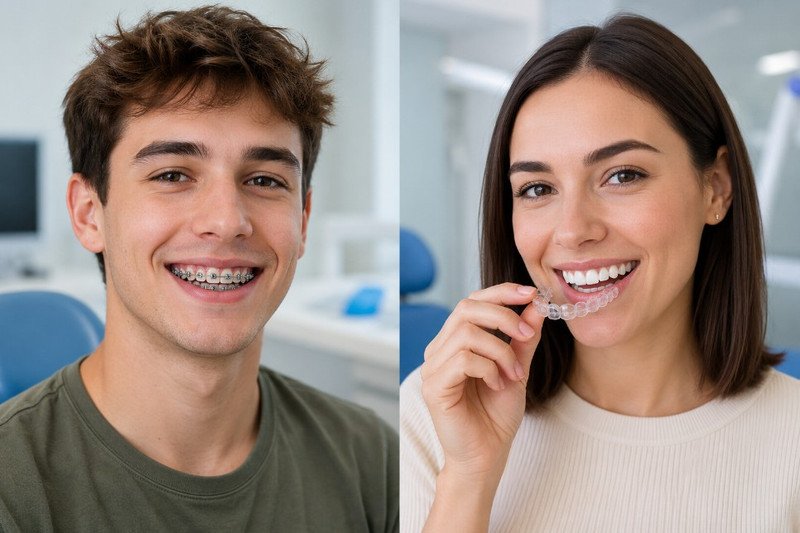
| Feature | Clear Aligners (with Attachments/Elastics) | Traditional Fixed Braces |
| Aesthetics | Virtually invisible; high patient discretion | Highly visible metal or ceramic brackets |
| Hygiene | Removable; easy to brush and floss normally | Fixed; requires complex cleaning around wires |
| Force Application | Pushing force is distributed across the entire tooth | Pulling force focused entirely on the bracket |
| Comfort | Smooth plastic; initial pressure, but no sharp metal | Can cause soft tissue irritation and mouth ulcers |
| Compliance Required | High (Must be worn for 22 hours a day) | None (They work automatically 24/7) |
| Extreme Skeletal Shifts | Limited without surgical assistance | Excellent control over severe skeletal corrections |
The Deciding Factor: The Importance of Specialist Care
If you have a highly complex case, the brand of plastic clear aligner you choose matters far less than the clinician who designs your treatment plan.
Clear aligners do not think for themselves; they are simply a tool used to execute a digital prescription. An experienced orthodontist uses specialised 3D planning software to manually plot the exact force, sequence, and timing of every single tooth movement. They know precisely where to place attachments, when to perform IPR, and how to balance your bite so that your teeth remain healthy and stable for life.
This is precisely why complex cases should never be treated using direct-to-consumer, remote “do-it-at-home” aligner companies. Without in-person diagnostics, comprehensive X-rays to assess root health, and professional monitoring, attempting to force severely crowded teeth or complex bites into alignment can result in irreversible damage to your jawbone, gum recession, or a permanently ruined bite.
Are You a Candidate for Clear Aligner Treatment?
While clear aligners can now comfortably treat roughly 90% of orthodontic cases, there are still a select few scenarios where traditional fixed braces or a combined surgical approach remain the gold standard:
- Severe Skeletal Discrepancies: Where the structural issue lies entirely within the size or position of the jawbones rather than the teeth themselves.
- Severely Rotated Molars: Teeth that need to turn more than 45 degrees can occasionally slip inside a plastic aligner tray, requiring fixed brackets to get sufficient leverage.
- Large Skeletal Open Bites: Where the front teeth cannot meet because the back jaw structure is severely misaligned.
The only definitive way to know if your complex crowding or bite issue can be resolved with clear trays is to undergo a comprehensive orthodontic consultation involving a 3D digital scan of your mouth.
Conclusion
Thanks to massive leaps in dental engineering, 3D tracking software, and composite attachment technology, clear aligners are no longer just for minor cosmetic tweaks. They are fully capable of resolving severe overcrowding, deep bites, crossbites, and complex tooth alignment issues.
Choosing aligners means you do not have to compromise your lifestyle, your professional appearance, or your dietary freedom to achieve a healthy, functional, and beautifully straight smile.